EN
EN

BNC to SMA Conversion: Video-to-RF Signal Routing
As an RF systems engineer working across telecom, security, and industrial automation deployments, I've found that connector and cable selection determines whether a signal chain performs to spec. A common interface challenge is the transition between BNC-equipped video or legacy RF equipment and SMA-based RF infrastructure. A successful bnc to sma connector conversion depends on understanding why these two interface families exist and which adapter configuration fits your system.
Why BNC and SMA End Up in the Same System
BNC (Bayonet Neill-Concelman) connectors have been a standard in video, test equipment, and low-frequency RF systems for decades. Their quarter-turn bayonet coupling makes them fast to connect and disconnect, and they are widely deployed in security cameras, broadcast video distribution (SDI), spectrum analyzers, and legacy measurement instruments. BNC connectors are specified to 4 GHz per MIL-STD-348, and they are available in both 50 Ω and 75 Ω impedance versions—an important distinction when routing video signals, which typically use 75 Ω infrastructure, into 50 Ω RF equipment.

SMA (Sub-Miniature version A) connectors, by contrast, are designed for applications where frequency range and physical compactness matter. Their threaded coupling per MIL-STD-348 and IEC 61169-15 provides a more secure, vibration-resistant interface rated to 18 GHz for standard versions and up to 26.5 GHz for precision variants. SMA interfaces are specified exclusively at 50 Ω, making them the dominant interface in wireless communications equipment, test instruments, antenna distribution, and compact RF assemblies.

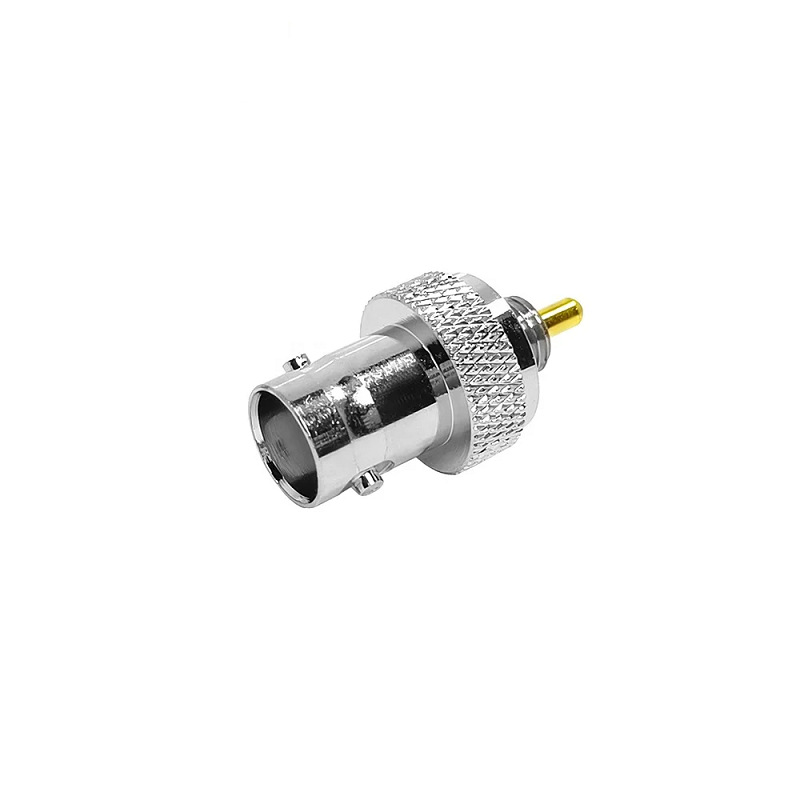
The overlap happens in hybrid systems: a security operator routes CCTV signals through a BNC-based distribution amplifier, then needs to feed a spectrum monitoring unit with SMA inputs. A telecom engineer integrates legacy BNC-terminated test equipment with modern SMA-based RF modules. An industrial automation integrator connects BNC-port sensors to SMA-equipped wireless communication devices. In each of these cases, a bnc to sma connector adapter—whether you need an sma female to bnc female configuration for back-panel connections, sma male to bnc male for two female-port devices, or another polarity combination—becomes the interface solution that keeps the signal chain intact without requiring a full equipment replacement.
Understanding BNC to SMA Connector Configuration Options
The first step before selecting an adapter is confirming the gender of the connectors already present on your equipment. This seems straightforward, but mixed connector gender issues are one of the most common sourcing errors in system integration projects. BNC and SMA each have male (plug) and female (jack) variants, and the adapter must bridge the correct gender on each side.
Common configurations include:
- SMA female to BNC female (sma female to bnc female): Used when the BNC side terminates a cable with a male BNC plug and the SMA device port presents as male. Both sides of the adapter are receptive. This bnc to sma connector configuration appears frequently in panel-to-panel RF distribution or when adding a conversion point in a fixed cable run.
- SMA female to BNC (sma female to bnc): One of the most versatile configurations for connecting BNC-terminated cable assemblies to SMA female instrument or module ports. Verify BNC gender on your specific equipment before ordering a sma female to bnc adapter to confirm whether you need male or female on the BNC side.
- SMA male to BNC male (sma male to bnc male): Used between two female-port devices; requires both the BNC device port and SMA device port to be female jacks. The sma male to bnc male bnc to sma connector adapter is common in back-panel connections between chassis-mounted equipment where both device ports are female jacks.
If you are uncertain which genders are present at each interface, physically inspect the connectors or check equipment documentation before placing an order. Ordering the wrong configuration and attempting to force-connect creates a real risk of thread or bayonet damage that is difficult to reverse without replacing the connector.
Key Selection Factors for Your BNC to SMA Connector
Once you've confirmed the gender configuration, the remaining selection criteria align with the performance requirements of your signal path.
Impedance Matching for BNC to SMA Connector Adapters
If your BNC equipment uses a 75 Ω interface—standard in video and SDI applications—you cannot directly substitute a 50 Ω SMA adapter without introducing a measurable impedance mismatch. For low-frequency video signals where content stays well below 1 GHz, the VSWR impact may be acceptable in non-critical monitoring scenarios. For any RF measurement or signal integrity-sensitive path, however, use a dedicated 75 Ω-to-50 Ω matching solution or redesign the signal chain to avoid the mismatch altogether. Standard SMA connectors are 50 Ω only.
Operating Frequency Range for the BNC to SMA Connector
The bnc to sma connector adapter you select must be rated to the highest frequency in your signal chain, not just the center or nominal operating frequency. If you are routing signals that extend to 3 GHz, verify that both the BNC and SMA sides of the adapter are rated above that ceiling. Precision BNC connectors engineered to tight dimensional tolerances—such as the BNC-ULTRA100 Precision BNC Connector, a 50 Ω stainless steel body unit compliant with MIL-STD-348—are designed to maintain contact geometry at the upper end of the BNC frequency range. Pairing it with a well-specified SMA connector rated across a broad frequency window, such as the RF-PRO-SMA-50M SMA Connector (50 Ω, 0–18 GHz, gold-plated brass, IP67), ensures that neither interface becomes the performance bottleneck in the conversion path.
Higher frequency ratings do not necessarily mean a more expensive component—dimensional control and material quality are the primary cost drivers for precision RF connectors, not the frequency specification alone.
Contact Plating and Body Material
For static indoor installations, nickel-plated brass adapters provide adequate corrosion resistance and are cost-effective. For outdoor use, high-humidity environments, or applications with frequent mating cycles, gold-plated contacts and stainless steel or passivated brass bodies deliver better long-term performance. Mismatched plating across the mating interface can accelerate galvanic wear at the contact zone over time.
Mechanical Coupling and Installation Environment
BNC's bayonet coupling is faster to connect than SMA's threaded interface, but provides less security under vibration. In industrial automation environments or installations subject to sustained vibration, the threaded SMA interface is more robust. If the application requires frequent disconnection—in test setups or portable equipment—the BNC bayonet side appropriately absorbs the reconnection cycles.
Signal Integrity and Installation Guidance
Every adapter interface introduces additional insertion loss and VSWR into the signal path. At 1 GHz, a quality BNC-to-SMA adapter typically contributes less than 0.1 dB of insertion loss; at 3 GHz this can rise to 0.2–0.3 dB depending on contact geometry and manufacturing tolerance. For most distribution applications this is acceptable, but engineers building precision measurement setups or operating near link budget margins should account for adapter loss explicitly when calculating system performance.
Avoid daisy-chaining multiple adapters in series unless necessary. Each additional conversion interface adds insertion loss and creates a potential impedance discontinuity. If your layout requires more than one adapter in sequence, a cable assembly with the required terminations on each end is typically a cleaner solution.
When installing the SMA side of a bnc to sma connector adapter, apply torque within the manufacturer's specification—typically 3–5 in-lb (0.35–0.56 N·m). Over-tightening can damage center pin alignment; under-tightening leaves the interface susceptible to vibration-induced intermittent contact.
Summary: Matching the Adapter to the Application
Selecting the right BNC to SMA connector—whether that is a sma female to bnc female barrel adapter, a sma male to bnc male back-panel unit, or any other gender combination—comes down to confirming four things before placing an order: the gender configuration on both sides, the impedance of the BNC circuit (50 Ω or 75 Ω), the maximum operating frequency of your signal path, and the mechanical environment the adapter will operate in. For standard 50 Ω RF-to-RF routing at frequencies up to 4 GHz, most quality adapters will perform adequately. For industrial deployments, precision measurement setups, or systems operating above 2 GHz, dimensional tolerance and material quality are the primary differentiating factors.
Worldpeak's RF connector range—including precision BNC and SMA connectors engineered to 18 GHz with pre-shipment electrical testing—supports procurement consolidation for engineers and integrators who need consistent electrical and mechanical specifications across multi-interface signal chains in telecom, security, and industrial automation applications.