EN
EN

uhf-male-to-uhf-female-lightning-arrester---dc---3-ghz, uhf-male-to-uhf-female-lightning-arrester---dc---3-ghz, /rf-lightning-arrester
EN
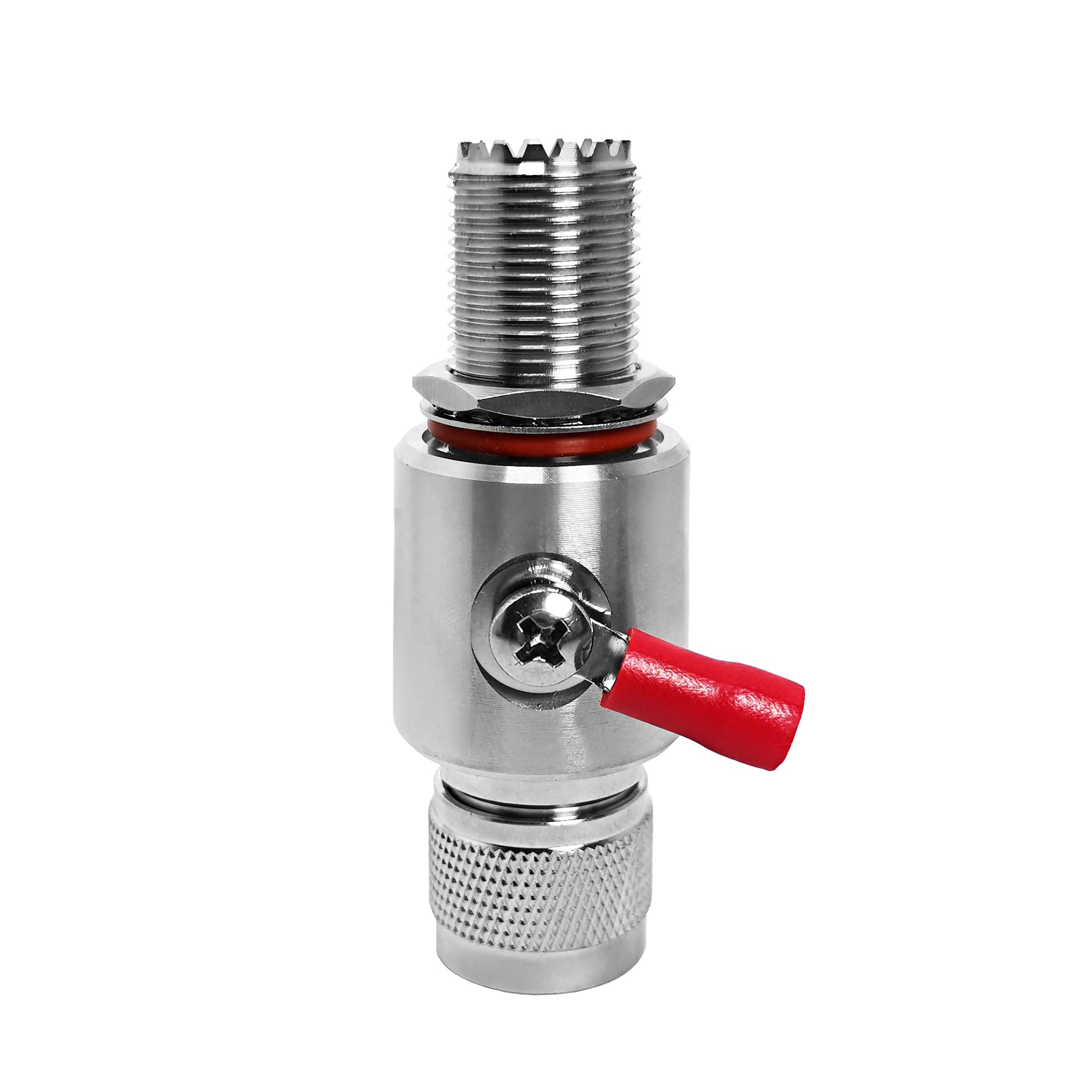
This UHF Male to UHF Female lightning arrester is a GDT based RF surge protector designed for DC - 3 GHz operation. It sits in the transmission line between the antenna and the radio equipment, diverting lightning-induced transients to ground before they reach the sensitive front end. The 50 ohm design holds insertion loss at 0.2 dB with a VSWR of 1.3 or better across the passband.
Request a Quote | Download Datasheet | Ask an Engineer
Product Overview
This UHF Male to UHF Female arrester is an RF surge protection point for 50 ohm coaxial runs from DC to 3 GHz. Its replaceable 90 V gas discharge tube is specified for 10 kA on an 8/20 us test wave. In normal service, the element remains high impedance while the line operates with 0.2 dB insertion loss; during a transient, it conducts toward the grounding lug.
Core Trade-off: This GDT arrangement keeps capacitance low and supports a replaceable protection element after a major event. Its trigger level is higher than that of diode-based protection, while the low-loss signal path is suited to many antenna-line installations.
Protection Mechanism and Construction
Reference Technical Specifications
The following figures are reference values for the UHF Male to UHF Female arrester. Confirm them against the final production configuration before use.
Technical item |
Listed value |
Reference note |
RF connector pair |
UHF Male to UHF Female |
Compatible RF termination |
Installation form |
Bulkhead |
Housing arrangement |
Nominal resistance |
50 ohm |
Line resistance |
Operating band |
DC - 3 GHz |
Supported spectrum |
Signal attenuation |
0.2 dB |
Within stated band |
VSWR |
1.3 |
Maximum |
CW power reference |
150 W |
Reference CW condition |
Arrester element |
90 V |
GDT element |
Transient current |
10 kA (8/20 us) |
8/20 us test wave |
Earth connection |
Ring terminal |
M4 earth-lead lug |
Housing composition |
Machined brass |
Protective surface plating |
Unit mass |
119.6 g |
Reference mass |
Typical use |
FM/AM broadcast and ham radio, PA system |
Intended use context |
These reference values apply to this protection family and require confirmation against the final production configuration.
Engineering Comparison
Applications
Installation and Grounding Notes
OEM and B2B Support
FAQ
Q: How often does the gas discharge tube need replacement?
A: The 90 V tube has a 10 kA rating on the 8/20 us test wave. After a major surge event, test the element; replace it if leakage is present or if it does not pass the hold-off test, without replacing the entire arrester.
Q: Will this UHF Male to UHF Female lightning arrester affect my DC - 3 GHz signal?
A: The listed passband values are 0.2 dB insertion loss and VSWR up to 1.3, providing a low-impact RF path for applicable antenna-line installations.
Q: Can I use this arrester indoors?
A: Yes. It may be fitted at the equipment end of a cable run as well as at an entry point where a second protection stage is required. For UHF Male to UHF Female lightning arrester selection, confirm connector compatibility and grounding access. This RF surge protector is used in compatible 50 ohm RF cable paths. The specified 3 GHz coaxial lightning protection range supports applicable radio installations. For FM/AM broadcast and ham radio surge protection, position the unit at the relevant cable entry. A UHF Male to UHF Female lightning arrester should be matched to the final production configuration. This RF surge protector requires an appropriate earth connection.