SMA connectors play an indispensable core role in RF and microwave applications. This type of connector not only has excellent performance, but also plays a crucial role in the RF microwave field. Its unique structure and design enable it to easily handle various complex application scenarios, providing strong support for the stable operation of RF microwave systems. Whether it is high-speed data transmission or precise control of microwave signals, SMA connectors have demonstrated their outstanding performance and indispensable position.
In the field of RF microwave, RF coaxial connectors play a crucial role. This type of connector is designed specifically for transmitting RF signals, and its operating frequency range is extremely wide, up to 18GHz or even higher. It is widely used in multiple equipment fields such as radar, communication, data transmission, and aerospace.
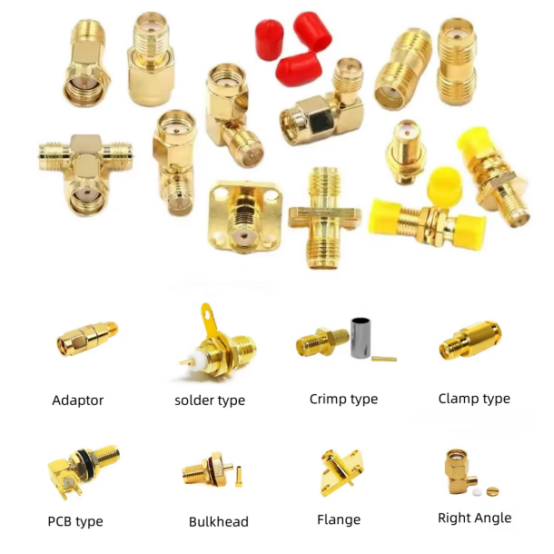
RF coaxial connectors, based on their unique structure, have inner and outer conductors tightly arranged around the same axis and supported by insulating media, thus forming an efficient transmission system. Its core function is to smoothly transmit various RF electromagnetic field signals and establish stable signal connections between various subsystems or devices of the communication system. As a passive port component, RF coaxial connectors play an indispensable role in communication systems. Today, we will delve into one type of RF coaxial connector - SMA connector.
SMA coaxial connector, abbreviated as SMA, is a widely used connector in the fields of radio frequency, microwave, and millimeter wave. The "SMA" in its name represents the subminiature version A, which has been a regular in the industry since its introduction in the 1960s. The MIL-STD-348 standard provides detailed specifications for the interface dimensions and other key parameters of SMA connectors, initially targeting applications at 12GHz. However, with the development of technology, standard compliant SMA connectors can now operate stably at power up to 18GHz without mode limitations. Moreover, some high-precision SMA connectors can operate at a power of up to 26.5GHz.
Due to its compact size, easy operation, and reliable performance, SMA connectors are highly favored in portable and laboratory testing equipment. Although some SMA connectors achieve precise parameter settings through carefully designed housing materials, in practical use, excellent performance can often be achieved simply by manually twisting them.
SMA right angle male connector, suitable for coaxial cables RG174, RG316, RG188, LMR-100, PE-B100, PE-C100, with a size of 0.1 inches. Due to the close relationship between the power processing capability and size of coaxial connectors, SMA connectors are typically suitable for low to medium power ranges rather than high power operation. This makes it shine in low-power interconnection within telecommunications applications and components. In many testing and measurement applications, SMA connectors have become the preferred choice as long as the power is below 18GHz, not only because of their high popularity and relatively low cost, but also because of their compact and small design. However, it is worth noting that although the SMA connector interface size is the same and interchangeable, the 3.5mm and 2.92mm connectors may face the risk of damage during frequent plugging and unplugging.
SMA straight female connector, equipped with clamping or welding accessories, adopts 4-hole flange installation method, with a hole spacing of 0.34 inches, suitable for various coaxial cables such as RG58, RG55, RG141, RG142, RG223 and RG400. It is worth noting that the insertion and extraction cycles of SMA connectors can usually reach more than 500 times, demonstrating their excellent stability. Similar to many common coaxial connectors, SMA connectors follow a "standard polarity" design, which means that connectors with internal interface threads also contain a central pin, known as "male" connectors. The outer shell also has threads, while the interior is equipped with a socket, namely a "female" connector. In addition, there are reverse polarity SMA connectors, which are mainly used in consumer devices such as wireless routers, with the center pin and socket positioned opposite to standard polarity connectors.
SMA can replace the female connector on site, using a 2-hole flange installation method, with a pin size of 0.015 inches and a hole spacing of 0.4 inches, and equipped with a metal ring. This type of connector is widely used in various coaxial cables with different shape factors, such as various types designed to connect coaxial cables, recyclable compression type board connectors, wall through connectors, adapters, and connectors with different bending radii. In most low-power applications, as long as the power is below 18GHz and the accuracy requirements are not very strict, SMA connectors have become the first choice for many people.
 EN
EN